


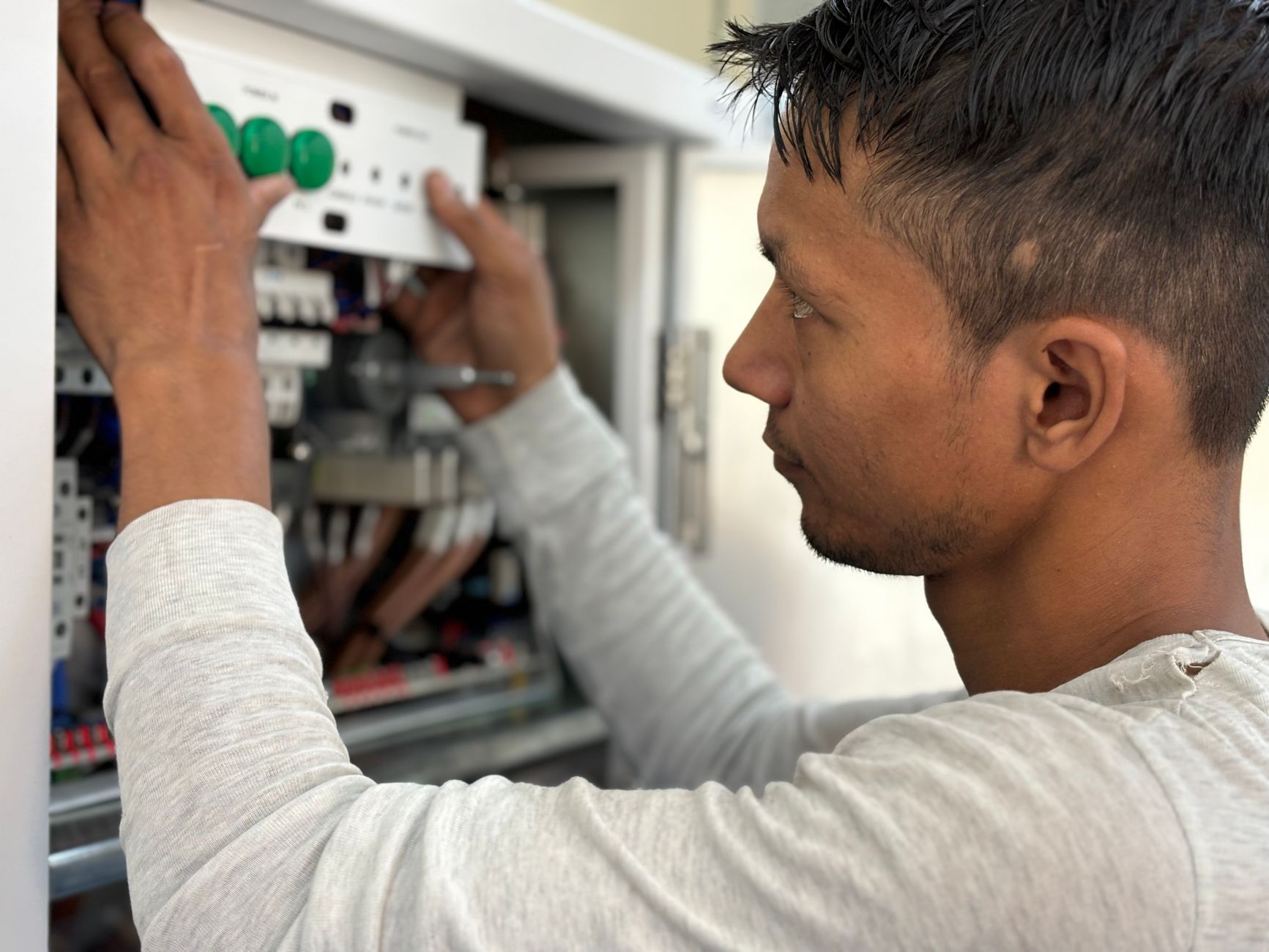
Switching to electrical work in your 30s is legally realistic — there’s no upper age limit to start — but financially realistic only if you can cover a 4 to 5 year dip to roughly 40 to 60 percent of journeyman pay before it climbs to a full wage.
That dip is the mechanism most career-change stories skip. Apprenticeship trades drop take-home pay before it recovers, so adults with rent and family costs need a year-by-year wage curve, not forum anecdotes. That lines up with current guidance published by BLS — median $62,350 in May 2024 and 9 percent projected growth 2024-34 — plus the published structure from the Electrical Training Alliance of 8,000 hours on-the-job and 720 to 950 classroom hours. The trade-off is stable long-term demand against short-term runway, physical work, and state hour requirements that vary. Once you see the actual progression and what your state board requires, you can verify your own runway before quitting — here’s how to check.
Why electrical work attracts career changers in their 30s
Electricians install, maintain, and repair power, communications, lighting, and control systems, and BLS notes almost all work full time with evenings, weekends, and overtime common. For someone in their early 30s looking for a second career, that reads as durable, hands-on work with a clear license path rather than another desk pivot.
The draw for career changers is usually two things at once: demand that looks stable and a wage that looks livable after training. As of August 2026, median annual wage for electricians was $62,350 per year, about $29.98 per hour in May 2024, with employment projected to grow 9 percent from 2024 to 2034, much faster than average, about 77,400 more jobs and about 81,000 openings per year from replacements and growth.
Those numbers don’t promise you a job or a salary. They do show why apprenticeship-based entry appeals when you already have bills. Most learn through an apprenticeship, some through technical school, and most states require a license, which creates a predictable structure. You trade short-term pay for a credential that travels.
The mechanism that makes this decision different from a bootcamp switch is that take-home pay drops before it recovers. You’ll earn a percentage of journeyman rate for years, not full rate on day one. Mapping that percentage curve against the BLS median lets you judge runway instead of guessing from anecdotes.
For a 30-something with fixed costs, that backdrop matters because the apprenticeship itself is the hiring path. You aren’t applying to be a licensed electrician on day one; you’re applying to a program that pays you while you accumulate hours.
How long does an electrician apprenticeship actually take?
As of August 2026, the standard structure published by the Electrical Training Alliance — the joint IBEW and NECA program — is a 4 to 5 year program requiring a minimum of 8,000 hours of on-the-job training plus 720 to 950 hours of classroom instruction depending on the local JATC.
One local example helps make that concrete. Scranton JATC describes its program as a four-period program requiring 8000 hours of on-the-job training and 720 hours of classroom. Austin Electrical Training Alliance lists a four-year schedule where 8000 hours required to test for journeyman license with the State of Texas. A trade profile of Gainesville notes over 8000 hours of work training and 720 hours classroom while earning wages based on a percentage of journeyman rate.
Those 8,000 hours aren’t arbitrary. Most state boards use 8,000 hours as the threshold to sit for journeyman exam, so the apprenticeship length directly determines license timeline. The program is accredited by the Department of Labor and typically includes evaluations every 1,000 hours.
Inside Wireman, Residential Wireman, and Outside Lineman are different tracks with different hours. Inside Wireman is the common path referenced in BLS data for commercial and industrial work. If your goal is residential only, hours and pay scale differ, which changes both timeline and runway math.
At the listing, look for your local JATC page stating program length in years, total OJT hours required, and classroom hours per year to compare against your state journeyman hour requirement.
How much do you earn while training versus after?
Here’s where the drop-then-recovery mechanism becomes calculable. As of August 2026, apprentice electricians typically start at 40 to 50 percent of journeyman rate and progress in steps tied to hours, not to asking for a raise.
Washington LNI apprenticeship standards for General Electrician show the official progression: Percentage of journeylevel wage rate 40 percent for 0-1,000 hours, 50 percent for 1,001-2,000, 55 percent, 60 percent, 65 percent, 70 percent, 75 percent, and 85 percent for 7,001-8,000 hours. Trade summaries put first-year typical pay at 40% to 50% of a journeyman’s wage, roughly $14 to $22 hourly in 2024 in many non-union markets, with union first-year examples $24 to $28 in Northern Virginia versus $14 to $17 non-union in the same area.
Year one feels slow because supervision is close and task complexity is lower. You are learning code, safety, material handling, and basic circuits under constant supervision. Reduced direct supervision comes later, which is why percentage bumps track hours.
Compare that to after. BLS median annual wage $62,350 in May 2024 is not a promise for year one post-license, but it anchors what recovery looks like in national data. Local journeyman rates vary by city and union status, and overtime changes annual take-home, but the progression from 40 percent to 85 percent is consistent across standards.
If you’re currently at $4,500 take-home, dropping to $2,800 in year one is a $1,700 monthly gap before taxes and benefits. That gap is the core reason career changers leave apprenticeships early, not lack of interest.
Is it too late to become an electrician at 30, 35, or 40?
No legal upper age limit blocks you. Eligibility guidance notes apprenticeship can start at 16 with no legal or regulatory upper age limit for becoming an electrician, and IBEW guidance states no strict upper age limit with most applicants in their 30s. The typical minimum is 18 and physically capable of doing the job, including work in many different environments, on the ground and above and below.
Physical demands are real and distinct from age. You may need to lift 50+ pounds, work at heights, stand for long periods, and work outdoors, in attics, or crawlspaces. That is a capability filter, not a birthday filter.
Maturity often helps in the application. Applicants in their 30s tend to have better time management, clearer goals, and higher completion commitment, which matters for a 4 to 5 year program. Employer cost is another factor: after year two, you handle more billable work, which is why programs pay more as you progress.
Hiring realities differ by market. Union IBEW programs pay 15 to 25 percent more at every step in Virginia, with first-year union $24 to $28 versus $14 to $17 non-union. That difference can be the difference between making rent and not during year one, so verify local JATC rates rather than national anecdotes.
What license do you actually need and why state boards matter before you start?
Licensing is state-issued, not national. Most states require electricians to be licensed, and conflating a national certificate with a state license causes over or under-investment in training that doesn’t count where you live.
Typical journeyman path as of August 2026: high school diploma or equivalent, 4 years minimum 8000 hours of work experience as apprentice under constant supervision of a qualified journeyman, plus classroom — for example 576 hours in Idaho — or education substitution. O*NET license info notes an applicant may substitute one year of education in approved electrical curriculum for 1,000 hours electrical experience, maximum 2,000 hours.
License types commonly include Limited, Journeyman, Master, Residential Master, and Provisional. A statewide license is typically required if the contractor proposes to bid, install, maintain, alter, or repair wiring for any amount, which matters if you plan to go independent later.
Reciprocity and fees vary. Texas requires equivalent out-of-state license for one year and exam for reciprocity. Tennessee Limited Licensed Electrician is 40 questions, 2 hours, $50 fee, 2-year license in one example. Electrician license types overview covers 50-state comparison, reciprocity, and insurance/bonding patterns, but you still need your specific state board.
Before you apply, check your state electrical board website for apprentice registration, required OJT hours for journeyman exam, and whether education hours can substitute for field hours. This is jurisdiction-specific as of August 2026 — do not generalize one state’s rule to another.
Try this before you apply: open your state electrical board site and note apprentice registration process, journeyman OJT hour minimum, classroom hour minimum, education substitution limit, and renewal cycle.
Why “just start earning right away” breaks down during year one
Advice that apprenticeship pay is good from day one sounds reasonable because qualified electrician median $62,350 and immediate access after NVQ plus AM2 completion in UK examples suggest quick earnings. It fails for career changers in their 30s in the US because first-year is typically 40 to 50 percent of journeyman, $14 to $22 typical even if union higher, with close supervision and lower task complexity.
Adult apprentices over 21 may be entitled to National Living Wage in the UK, but US structure still pays a percentage. Without runway savings, low initial pay forces dropout even though work is available. The mechanism is pay drops before it recovers, not lack of demand.
If a forum thread says first-year was great money, check whether that poster was in a high-rate union local, had overtime, or already had hours from prior electrical work that bumped percentage. Your first-year without prior hours starts at the bottom of the scale.
Career-transition financial-runway table — how to check before you quit
This table is the deliverable for this career change. It is a practical evaluation tool created for this guide based on official BLS median wage, Washington LNI percentage progression, and Electrical Training Alliance hour structure, not a published hiring standard or guaranteed outcome.
| Year | % of journeyman | Typical hourly & annual | OJT & milestone |
|---|---|---|---|
| Year 1 | Illustrative 40-50% | Approx $16-20/hr non-union, $24-28 union VA; ~$33k-42k annual | 0-2000 hrs — close supervision, safety & code basics |
| Year 2 | Illustrative 50-60% | Approx $19-24/hr; ~$39k-50k annual | 1000-2000 hrs — basic installs under direct supervision |
| Year 3 | Illustrative 55-65% | Approx $22-28/hr; ~$45k-58k annual | 2000-4000 hrs — reduced direct supervision |
| Year 4 | Illustrative 60-75% | Approx $26-32/hr; ~$54k-66k annual | 4000-6000 hrs — near-journeyman tasks, 576+ classroom typical |
| Year 5 | Illustrative 75-85% | Approx $28-36/hr; ~$58k-75k annual | 6000-8000 hrs — 900 classroom hours over 5 years example Carolinas |
| Journeyman | 100% — BLS median $62,350 | BLS May 2024 median $29.98/hr national context | License exam after 8000 hours — varies by state |
Financial runway table showing year-by-year percentage of journeyman, typical hourly ranges, and cumulative OJT hours
Key Takeaway & Executive Summary
Financial runway table showing year-by-year percentage of journeyman, typical hourly ranges, and cumulative OJT hours
Use the table to fill your own numbers. Two real examples of living-cost comparison help:
- Current take-home $4,500 versus Year 1 $2,800 creates approximately $1,700 monthly shortfall. Over 12 months that is about $20,400 needed from savings or partner income before overtime.
- If partner income covers rent and you have 6 months savings, you can cover Year 1 but still need plan for Year 2 at 50 to 60 percent before pay climbs to near median.
Before committing, verify: calculate your own Year 1 to 2 take-home using local journeyman rate times 40 to 50 percent and compare against actual monthly expenses for 12 months plus emergency buffer.
For readers considering related trades after running these numbers, our guide on renewable energy careers without an engineering degree covers solar installer and wind tech as trade-entry roles that BLS shows as fastest-growing and where electrician skills transfer, a natural next read after calculating runway.
What to check first
Check your local JATC for 8,000 hours OJT and 720 to 950 classroom structure, then check your state board for journeyman hour minimum and education substitution rules, then calculate Year 1 at 40 to 50 percent of local journeyman against your actual monthly obligations. Switching in your 30s is realistic when you have 12 months of shortfall covered and a clear path to license hours, not just enthusiasm for the trade. If you skip the runway math, the short-term dip, not ability or age, ends the switch early.
Frequently Asked Questions
Is 30 too old to start an electrician apprenticeship?
No, there is no legal or regulatory upper age limit and IBEW guidance notes no strict upper age limit with most applicants in their 30s. Minimum is 18 and physically capable of the job. Maturity helps completion, but physical demands and financial runway still filter realistic timeline, so verify local JATC.
How much do electrician apprentices make in the first year compared to after?
First-year is typically 40 to 50 percent of journeyman, approximately $14 to $22 typical US, union example $24 to $28 Northern Virginia versus $14 to $17 non-union. Progression follows percentage steps 40, 50, 55, 60, 65, 70, 75, 85 percent per 1,000 hours. After license, BLS median is $62,350 May 2024 national, local rates vary, so calculate shortfall before quitting.
How long does it take to become a licensed electrician after starting at 30?
Electrical Training Alliance structure is 4 to 5 years with 8000 hours of on-the-job training and 720 to 950 classroom hours, and 8000 hours required to test journeyman in Texas. Carolinas JATC example shows 900 classroom over five years, Idaho requires 4 years 8000 hours plus 576 classroom. Verify your state board, as licensing is state-issued.
What license requirements should I check in my state before switching careers?
Most states require a license, typically 8,000 hours under supervision for journeyman with education substitution up to 1,000 hours per year max 2,000. Check license types, fees, and reciprocity rules like Texas requiring equivalent license one year plus exam. For a 50-state overview see electrician license types guide, then verify your state electrical board as of August 2026, since rules are jurisdiction-specific.
{
